
Reimagining Adult Social Care at Surrey County Council
Surrey County Council is a local government body supporting a population of around 1.2 million people. I worked with them to explore how Adult Social Care services could be modernised and made more resident-centred.
The challenge
For people who need Adult Social Care (ASC) support, getting help shouldn't be harder than it needs to be. Surrey County Council's ASC service exists to connect vulnerable residents with vital support - but the path to accessing that support had become unnecessarily complicated.
The process starts with a lengthy online assessment form, followed by an in-depth call from an ASC team member for those who qualify. While the intention behind this process is sound, both residents and staff were feeling the friction. The form was long, complex, and difficult to navigate. Behind the scenes, staff were managing time-consuming manual processes and working within systems that weren't fully meeting their needs.
The council wanted a clearer picture of where the service was falling short, and a practical vision for what a better experience could look like.
What I did
With tight timelines to work to, I ran a rapid but thorough programme of research and analysis across four key areas:
Auditing the assessment form: I worked through the form step-by-step, looking at it from the perspective of someone trying to access support for the first time - often during a stressful and difficult period of their life. I identified where the form was unnecessarily long, confusing, or likely to put people off completing it, and put together a set of practical recommendations to make it simpler, quicker, and less daunting.
Mapping the end-to-end journey: Working closely with ASC staff, I mapped out how the initial assessment service - referred to as the ‘front door’ - actually operates from start to finish. This meant looking at where online and offline interactions connect, how data moves through the system, which tools and platforms are used, and where staff have to step in manually to keep things moving. Laying this out clearly made it much easier to spot inefficiencies and pinpoint where the experience could be improved for both residents and staff.
Understanding the internal system: Through a series of interviews with ASC team members, I explored the internal system they use day-to-day to manage applicants and casework. I listened to the challenges they face, the workarounds they've developed, and where they see the biggest opportunities for improvement.
Designing a future vision - including AI: Using everything I'd gathered, I created future state service blueprints showing what a redesigned ASC journey could look like. The council was considering reorganising some of its workflows to create a more efficient triage process, so I mapped out what this could mean in practice for staff and residents moving through the system.
A key part of this future vision was exploring where AI-enabled tools could genuinely add value. Human connection is irreplaceable for a service like Adult Social Care, but I identified areas where AI could be used smartly, freeing up staff to focus their time where it matters most.
For example, by reducing repetitive admin, improving how information is captured, and better supporting staff in making well-informed decisions.
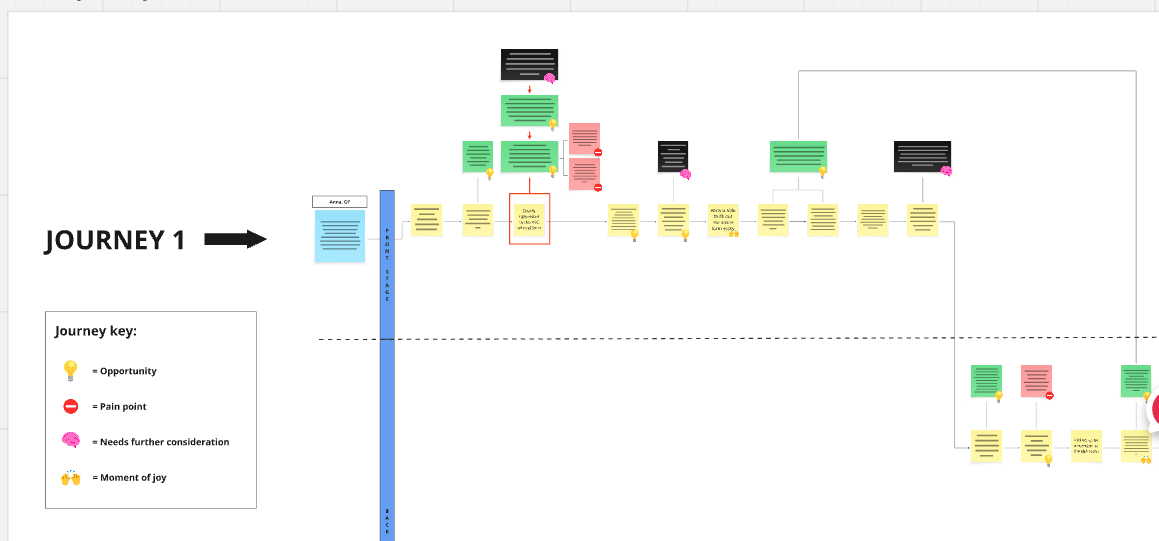
Image: Example snippet from a future state journey map
The outcome
I presented the findings and recommendations to senior management, giving the council a clear and evidence-based foundation to work from. The work has since helped shape a programme of improvement across the ASC service, with the council now taking steps to transform how it delivers support to some of its most vulnerable residents.